Michigan Palisades Nuclear Plant
Located in Michigan, this PWR reactorPWR reactorThis reactor is a PWR reactor - a pressurized water reactor. This is a specific type of Nuclear Reactor--in that it is pressurized water. This is also the most common type of reactor used and produced. The fuel rods are pressurized with helium, and the fission gas products result in more stability; as fuel "burns" in the reactor, the density increases resulting in small voids developing. Helium pressurization is necessary as these voids can cause potential rupture of fuel rods. Furthermore, the plant was shut down on May 20, 2022 after 40 years of commercial operation. The plant produced 800MW before being put under plans for decommissioning. However, upon pressure from political and environemntal groups, the plant is now being planned for reopening.
This plant is mainly targeted by anti-nuclear groups who do not want the plant to reopen, and also had a incident relatively recently of a man falling into the reactor cavity.
Context
Michigan Palisades is being planned for recomissioning, after a $400 million investment by US DoE Gov. Gretchen Whitmer.
Holtec purchased the facility in June 2022 with intent to decomission it, but reversed among pressure to retain carbon-free power. Holtec plans to deploy 2 SMR-300 reactors, capable of generating 300MW each, 600MW total, and 1.4GW combined with the original PWR.
Anti-Nuclear pushback
Beyond Nuclear, Don't Waste Michigan, and Michigan Safe Energy Future are three groups that have filed lawsuits and peittions to block the reponeing of the nuclear plant, arguing against regulatory exemptions and citing concerns due to age & alleged poor maintenance.
The brunt of Beyond Nuclear's pushback has been targeted against the steam generator tubes of the PWR reactor. These tubes are part of the steam generator:
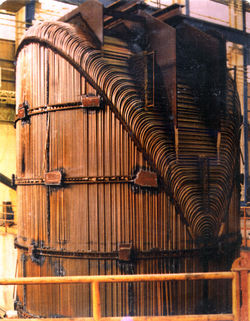
Beyond NuclearBeyond NuclearBeyond Nuclear is an anti Nuclear Reactor and anti-nuclear nonprofit. They release news on nuclear reactors, taking a anti-nuclear stance. Recent news has primarily been targeting the Michigan Palisades Nuclear Plant. Side note, what is up with their pictures?? Beyond Nuclear, please learn to take better pictures. Your message really degrades when I see a photo thats so pixelated I can visibly count each pixel. According to my file editor, your Save Lake Michigan photo is 105x150 pixels, but i alleges that Holtec committed "band-aid" fixes on these steam generators, with a nuclear engineering expert witness testifying that a single tube failure would result of release of radioactivity to the environment.
Kevin Kamps, BN's Radioactive Waste specalist issued this statement: “Although NRC Staff and Holtec International would like everyone to believe the Palisades atomic reactor’s unprecedented restart is a done deal, our environmental coalition begs to differ.
The zombie reactor restart scheme is unneeded, insanely expensive for the public, and extremely high risk for health, safety, security, and the environment.
NRC Staff has determined there are no significant hazards to consider? How about the future well-being of the Great Lakes Basin — 21% of the entire planet’s surface fresh water — and all who call it home?
What about the risk of a Chornobyl- or Fukushima-scale catastrophe at Palisades? NRC is enabling Holtec to play radioactive Russian roulette on the Lake Michigan shoreline. It is a grand nuclear experiment, and those of us downwind, downstream, up the food chain, and down the generations are the potential guinea pigs."
Personal Commentary
I find it offensive that a RW specalist speaks about the failure of the steam generation lines as a ChernobylChernobylChernobyl Nuclear Power Plant, located in Pripyat, Ukraine (USSR) was a Nuclear Reactor that suffered a catastrophic incident leading to massive radiation release across Europe due to winds, and led to massive casualties. Context Chernobyl was a RBMK Reactor which used graphite for neutron moderation and water for cooling. At the time of commissioning, CNPP had 1 800MW reactor and 3 1000MW reactor, with a stated capacity of 3515MW and a total thermal capacity of 12800MW. The design of an RBMK or Fukushima ReactorFukushima ReactorThe purpose of this page is to inform people of what happened at Fukushima and the reactor incident, and to give information about the plant itself. (present tense will be used throughout this) Fukushima Reactor Fukushima Daiichi NPP is plant that hosts 6 BWR reactors, using Light Water. This resulted in Fukushima being capable of delivering a combined power of 4.7 GWe (4700 MWe). Units 1, 2, and 6 were made by GE, 3 & 5 by Tobisha, and 4 by Hitachi. All 6 reactors were designed by GE. Unit 3 disaster level. As a specalist, Kevin knows that Chernobyl is not in any way related to modern PWR reactors. In fact, Chernobyl was a RBMK reactor, built with a positive void coefficient, and subpar cooling systems, combined with soviet-era testing protocols and pressure from authorities to perform, not at all similar to the way the NRC regulates things. In fact, I would say that the NRC takes the complete opposite approach, regulating nuclear safety to the nth degree, even a bit too far. Furthermore, Fukushima was the result of poor planning (ignoring flood warnings and placing the EDGs underneath the plant) and extremely poor media representation (The explosion wasn't even of the reactor core! It was the result of reactor claddingreactor claddingCladding is the thin walled metal tube that composes the outside of a fuel rod. It's purpose is to prevent corrosion of the fuel by the coolant & release of fission contents into the coolant. Although Zirconium alloy is common, aluminum and stainless steel is also used. Cladding Types Zirconium alloy has been used for so long due to it's properties being very good for nuclear reactors. * New research suggests that there is an alternative - SiGA cladding. This cladding is made from silicon car converting to hydrogen gas and reaching the flash point). Kevin misrepresents these events to attempt to deliver an impactful statement, riding on the fears of the audience and grossly misrepresenting nuclear reactors.
Also, does Kevin forget that the NRC performs massive amounts of accident calculations, accounting for almost every type of incident? In fact, the incident Kevin describes here is documented, and the worst case release would be "not exceeding a few hundred curies of I-131 for leaks of up to 1000 gpm for 40 minutes". And remember, this is a worst-case scenario. In a real life incident, operators would be quick to recognize the leak and isolate flow, and these leak rates would not be achieved. Also, although I-131 sounds dangerous, it has a half-life of 8 days, allowing it to decay completely in months, making it significantly less of a risk. (150,000,000 million curies were released from 90 US nuclear tests, 189 curies released into seawater by Fukushima, and 5,400,000 curies released into the atmosphere by Fukushima). From these numbers, a few hundred curies of I-131 is minimal in comparison to a true disaster.
Man Fell Into Reactor Cavity
On October 21, 2025, a man fell into the reactor cavity of the plant. The reactor cavity is the passageway between the pressure vessel of the reactor core, and the spent-fuel-pool. They were decontaminated but had 300 CPM detected in their hair, being sent offsite to be treated.